
Hotelier's Digest #11: From Systems of Record to Systems of Intelligence

Hotel technology companies are increasingly describing the future through the same lens.
This week's edition looks at Mews' vision for agentic hospitality, Lighthouse's launch of Ernest, a Perplexity and Harvard Business School study on AI-driven knowledge work, and a Lights On interview with Josh Graham from Cloudbeds.
The common thread is not artificial intelligence itself. It is the race to build systems that understand hotel context. Whether they are called semantic layers, intelligence layers, or AI workspaces, the goal is increasingly the same: understand what is happening, recommend what should happen next, and reduce the work required to execute it.
Featured Analysis
"The hospitality industry doesn't have a software problem. It has an intelligence problem."
- Mews
Mews' article on the agentic future of hospitality is worth reading because it reframes the AI discussion. The article is not really about chatbots. It is about context.
Most hotels already operate with a large collection of software. Property management, revenue management, POS, housekeeping, payments, guest messaging, finance, distribution, and reputation management systems all contain valuable information. The challenge is that each system sees only part of the operation.
The most important idea in the article is the concept of a hospitality "world model" built on a shared semantic layer. Mews argues that AI becomes useful when reservations, rooms, rates, folios, tasks, payments, and guest profiles are defined consistently across systems. Without that shared language, every AI deployment becomes a custom integration project. With it, agents can reason across departments because they understand how operational events connect to one another.
This distinction matters because the near-term opportunity is not autonomous hotels. It is reducing coordination work. Mews describes agents that route tasks, suggest room assignments, identify guest opportunities, support rate changes, and assist with multilingual communication. In nearly every example, the system proposes actions while staff retain approval and accountability.
Mews also extends the argument beyond operations. As AI-assisted travel planning grows, hotels with richer and more structured property data may become easier for external agents to understand, recommend, and sell.
For independent hotels, this is ultimately a data-discipline challenge. Room types, packages, policies, amenities, guest profiles, task workflows, and content descriptions all need to be structured consistently. The hotels that organize operational data well today will be in a stronger position as AI systems become more capable tomorrow.
Revenue and Commercial Strategy
"One workspace, the full commercial picture."
- Ernest
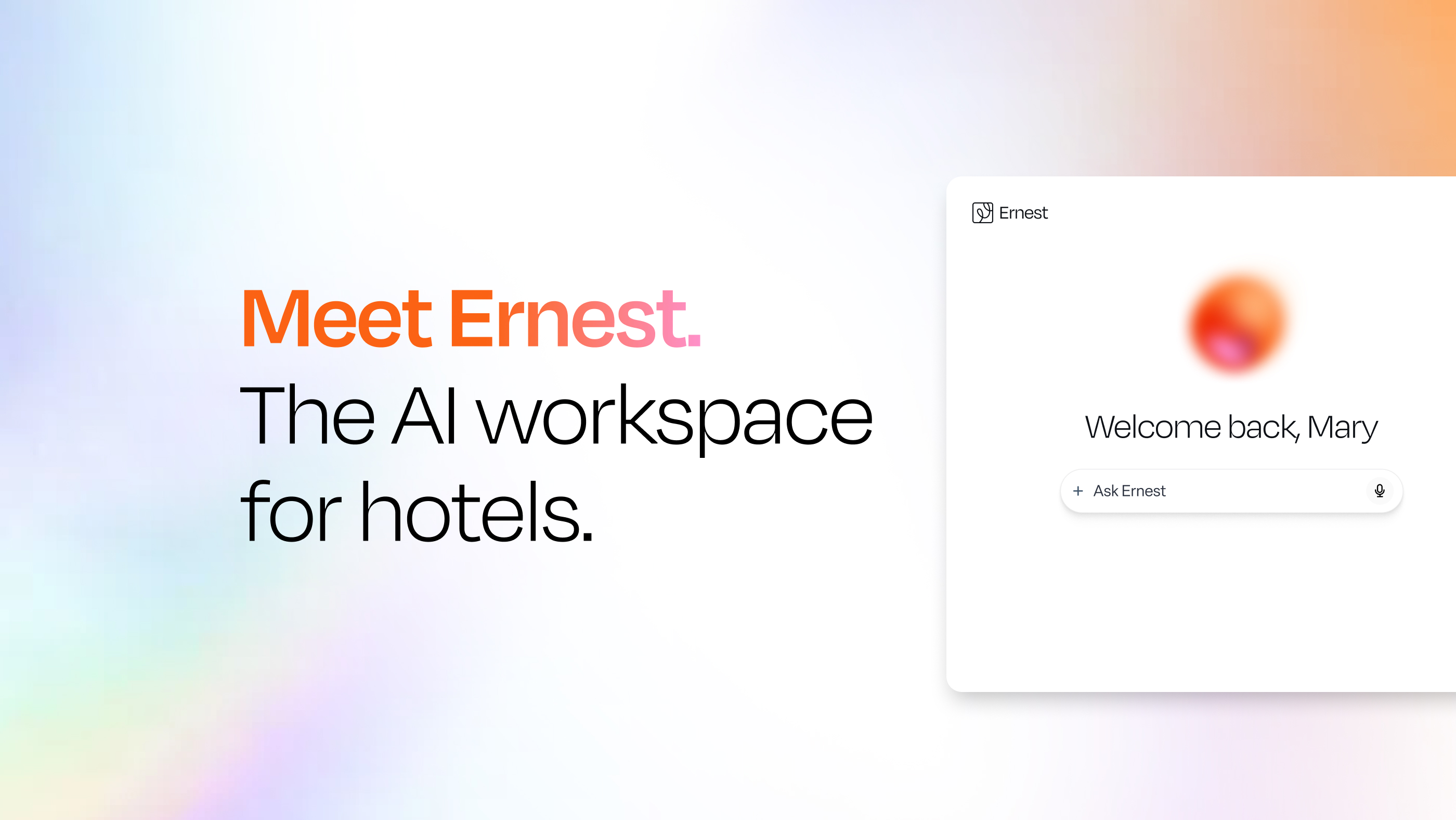
Lighthouse's Ernest platform tackles the same problem from a commercial perspective. Where Mews focuses on creating a shared operational understanding across hotel systems, Lighthouse focuses on helping commercial teams turn that understanding into decisions and actions.
CEO Sean Fitzpatrick describes Ernest as the "last mile" between general-purpose AI and hospitality-specific outcomes. The argument is that large AI models are increasingly capable, but they do not understand a property's market, systems, strategy, or operating constraints.
Ernest is designed to bridge that gap. It combines Lighthouse intelligence with data from PMS, CRS, booking engines, and other hotel systems to create a commercial workspace where teams can ask questions, review recommendations, and execute actions without moving between platforms.
What stands out is that Lighthouse is not positioning Ernest as a reporting tool. It is positioning it as a decision-support layer. The platform is designed to deliver intelligence, recommend next actions, and execute approved tasks across connected systems. In other words, the objective is not more analysis. It is reducing the time between identifying an opportunity and acting on it.



Operations and Leadership Insight
"Agents shift AI usage from looking things up and synthesizing them to planning and carrying out tasks autonomously."
- Perplexity Research
A June 8 study from Perplexity and Harvard Business School researchers provides a useful perspective outside hospitality.
The research compares traditional AI-assisted work with agent-based workflows and finds that while agents require more direction upfront, they reduce the amount of manual effort required during execution. Users spend less time completing individual tasks and more time defining objectives, supervising outcomes, and reviewing results.


The implications for hotels are straightforward. Revenue managers, owners, and general managers still make the decisions, but much of the preparation behind those decisions can become automated.
Instead of gathering pace data, events, pickup, comp set activity, restrictions, channel mix, and group information from multiple systems, future platforms may assemble that picture automatically and recommend next steps.
That shifts the leadership requirement. Teams need stronger approval processes, clearer operating rules, better exception handling, and disciplined review habits. Accountability does not disappear. The work simply moves from collecting information to supervising its application.
Media Recommendation
5 Questions That Separate Real Hotel AI From Expensive Guessing Games With Josh Graham is this week's media pick. The conversation features Josh Graham, Head of Market Development for North America with Cloudbeds PMS, and Kin Sio of Lights On. It is worth watching because it sits closer to the operator's reality than many AI discussions. The useful question is not whether a tool says "AI" on the product page. It is whether the system understands hotel context, connects to the workflows that matter, and helps staff make better decisions without creating another layer of guesswork.
Destination or Hotel Spotlight
The Huntington Hotel San Francisco, California
AFAR's recent review of the newly renovated Huntington Hotel highlights an important reminder that extends beyond technology: property positioning still matters.
Following an extensive renovation, the Nob Hill property is emphasizing its history, service culture, design, and guest experience rather than focusing solely on the renovation itself.
 https://www.afar.com/authors/heidi-mitchell
For hotel operators, there is a broader lesson. AI-driven discovery platforms increasingly rely on both structured and unstructured information to understand and describe properties.
A renovation requires more than new photography and updated rates. Hotels need clear messaging about what changed, who the property serves, what makes the experience distinctive, and why guests should care. That story should be reflected consistently across the website, booking engine, OTA listings, review responses, and sales materials.
Good content is no longer just marketing. It is part of the data layer that future discovery systems will use to understand and recommend a property.
Closing Reflection
A year ago, most AI conversations in hospitality focused on chatbots and content generation.
This week's stories suggest the industry is moving in a different direction.
Mews is building a semantic layer that helps systems understand hotel operations. Lighthouse is building an intelligence layer that helps commercial teams move from insight to action. Perplexity's research shows how agents are changing the way knowledge work gets done. Even the discussion from Cloudbeds centers on whether technology can understand operational reality rather than simply process information.
The common challenge is no longer collecting data. Hotels already have plenty of data. The challenge is connecting information across systems, establishing clear operating rules, and turning insights into consistent action.
For most properties, the work remains practical. Improve data quality. Structure content clearly. Define workflows. Establish approval processes. The hotels that do that work now will be in a stronger position as technology shifts from systems of record to systems of intelligence.